Automation That Actually Saves Time
Good automation removes repetitive work, reduces errors, and gives people more time to focus on decisions that matter.
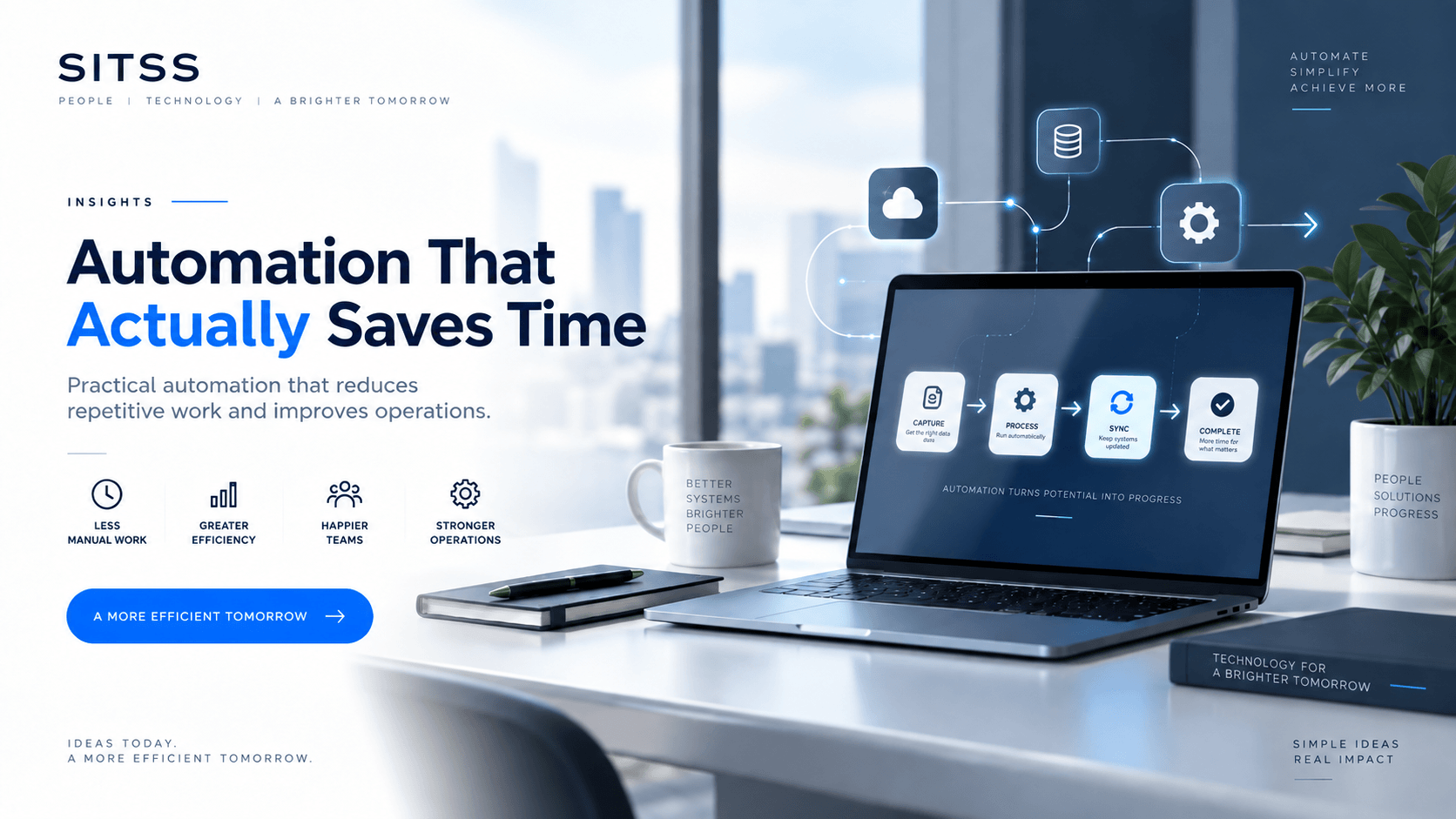
Automation is often introduced with one promise: save time.
But not every automated process actually makes work easier.
Some simply move complexity from one place to another. Others introduce new tools, new steps, or new maintenance requirements without delivering meaningful improvement.
The goal should not be automation for its own sake.
The goal should be better operations.
Start with repetitive work
The best candidates for automation are usually tasks that are:
- repeated frequently
- rule-based
- time-consuming
- prone to human error
- dependent on the same data moving between systems
Examples include routine notifications, status updates, data entry, report preparation, approval routing, and synchronization between platforms.
These tasks may look small individually, but across a team they can consume a significant amount of time.
Automate the process, not the problem
Before automating anything, the existing workflow should be reviewed.
If a process is inefficient, automating it can simply make the inefficiency happen faster.
A better approach is:
- understand the current workflow
- remove unnecessary steps
- simplify decision points
- automate what remains
This usually produces a cleaner result than starting with a tool and trying to force the process into it.
Keep people where judgment matters
Not every decision should be automated.
Processes involving context, relationships, exceptions, risk, or strategic judgment often still need human involvement.
The strongest automation usually handles the predictable parts while allowing people to focus on the work that requires experience and judgment.
That balance matters.
Integration is often more valuable than another system
Many organizations already have the tools they need.
The problem is that those tools do not communicate well with each other.
Instead of introducing another platform, the better solution may be to connect existing systems so information can move automatically.
That can reduce duplicate data entry, improve accuracy, and make processes easier without replacing everything already in use.
Measure what improved
Automation should produce a visible result.
Useful questions include:
- Did processing time decrease?
- Were manual steps removed?
- Did error rates improve?
- Did employees spend less time on repetitive tasks?
- Did customers receive faster responses?
If the answer is unclear, the automation may not be solving the right problem.
Practical automation creates capacity
The real value of automation is not simply doing work faster.
It is creating more capacity for people and organizations.
When repetitive work is reduced, teams have more time to focus on customers, planning, innovation, and improvement.
That is where automation becomes more than a technical feature.
It becomes a business advantage.
At SITSS, we believe automation should be practical, measurable, and designed around how people actually work.